New Food and Travel Blog
Bologna is still dear to my heart but I've launched a new blog about food and travel called silverstreaker. It's for people who like to get off the beaten track. There will be travel tales, visits to food and drink producers, restaurant reviews and recipe. See you at silverstreaker.wordpress.com

Photos: Liz Cousins
Monday, 21 April 2014


Wednesday, 11 April 2012
On sale now - Foodlovers' Bologna
It’s out now – Foodlovers’ Bologna the e-book of the blog with loads of full colour spreads, new recipes and reviews and interviews.

Foodlovers’ Bologna follows on the heels of acclaimed blog, www.tasteforbologna.blogspot.com,
with 240 pages of reviews, interviews, visits to the best artisan producers,
authentic recipes to try at home plus how
to spend 48 hours in Bologna. Specially designed for the i-pad with dozens of
full colour spreads, this e-book looks good on any computer or smart phone.
It doesn't work on Kindle or Kobo (or any other device that can't cope with double page spreads and colour).
Use it in the kitchen, use it as your guide in food-mad Bologna or drool over it almost anywhere. Download the pdf now from i-tunes for £5.99 or $11.99 - http://itunes.apple.com/us/book/foodlovers-bologna/id521148245?mt=11
Or go to Paypal. Once Paypal has accepted your payment it emails me to confirm you have paid and then I send you your personal copy of the book.
It doesn't work on Kindle or Kobo (or any other device that can't cope with double page spreads and colour).
Use it in the kitchen, use it as your guide in food-mad Bologna or drool over it almost anywhere. Download the pdf now from i-tunes for £5.99 or $11.99 - http://itunes.apple.com/us/book/foodlovers-bologna/id521148245?mt=11
Or go to Paypal. Once Paypal has accepted your payment it emails me to confirm you have paid and then I send you your personal copy of the book.
Thursday, 5 January 2012
The book of the blog - coming soon
 |
| Negotiating about food: the big business in Bologna |
Bologna is Italy's
food capital. Who would dispute that in Italy? Yet here in England (and probably in the US too), while the
bookshops are full of cookery books about Tuscany and Sicily, there's nothing
on Bologna. Liz Cousins and I - who have been visiting the city for 30 years -
decided last year to rectify that by writing a book about the relationship
between the Bolognese and food, a mixture of tourist guide and cookery book.
‘Foodlovers’
Bologna – a guide to eating, drinking and shopping with classic Bolognese
recipes’ will be published as an e-book in March. Like A Taste for Bologna, it will introduce the best and most interesting
restaurants and restauranteurs to an English-reading readership. It will
feature the classical ingredients of Bolognese such as parmigiano, mortadella
and prosciutto, and the people who produce them. It will centre on the city but
take readers on a tour around Bologna the province. We will even visit Modena
and Parma. The book will demonstrate that tagliatelle al ragu, tortellini and lasagne
- the best known dishes abroad - are part of a large and rich culinary
tradition. One that is an essential part of life for the Bolognese.
Watch out for a pre-publication offer on this site. Let us know if you want to buy.
Watch out for a pre-publication offer on this site. Let us know if you want to buy.
Thursday, 29 December 2011
Learning to cook in Bologna

Learning to cook is the new tourist activity and in Bologna
there is plenty of choice whether you want an introductory day or something
longer and more serious. The Council’s website lists 16 local cookery schools: http://informa.comune.bologna.it/iperbole/turismo/luoghi/39065
We tried three places:
Alessandra Spisne’s la Scuola Vecchia on via Malvasia, Marcello dall’Aglio’s course at Locanda del
Castello and the Scuola Cucina di Bologna in via del Pratello. These all offer
a range of courses from amateur to professional, varying in length from an
evening to several months. All focus on
bolognese cuisine but not exclusively - vegetarian dishes and food from other
parts of Italy and the world also get a look in.
I signed up for a morning’s pasta making with Aurelia, the
sfoglina at Locanda del Castello, and learnt a lot of useful tips. Evening
courses at la Locanda and at La Scuola Cucina are useful for introducing a
range of techniques and dishes. Of course, if you want to become really
proficient in cucina bolognese you will need a month at least and more likely
three months in one of these cookery schools or La Scuola Vecchia before you
can expect to earn a living in a professional kitchen.
Contact
details
La Scuola Vecchia
via Malvasia, 49 - 40131 Bologna - tel: 051
6491576 -
La Scuola Cucina di
Bologna
Enquiries to Cultura
Italiana (language school), to which it is linked, at Via Castiglione, 4
I - 40124 Bologna
tel. +39 051228003 +39 051228011 +39 051227166
tel. +39 051228003 +39 051228011 +39 051227166
3 ½ hour evening
class costs from euro 35 in a group of 8-15.
La Locanda del
Castello
Via Palazzo de'
Rossi
Pontecchio Marconi
Sasso Marconi
Bologna
+39 051 6781172 or mobile 348 4402943
Single evening
lesson: euro 60
Tuesday, 13 December 2011
Mortadella - uniquely Bolognese
‘I can’t say it’s better than the others. All I can say is that a lot of people prefer it to the others.’
Pasquini is a no nonsense, bear of a man who meets us with his arms folded and a look of undisguised scepticism. In his late 70’s, after half a century, he is still very much in charge of the business, very conscious of its importance.
 |
| Ennio Pasquini - traditional hand made mortadella |
Bologna is known the world over for a cooked sausage, the mortadella, that has its origins in the 16th century. There are many firms around Bologna entitled to stamp their mortadella IGP, as a European protected product, but Pasquini is the only one within the city walls. Moreover, it is the only truly artisanal producer, with much of the work done by hand, especially of the salame rosa variant. Including the boss, there are just seven workers. The output is a tiny 20 quintals a week, or 2000 kilos. Not a lot compared with the 37 million kilos produced in 2006 by the 30 companies that make up the Bologna Mortadella Consortium.
 |
| Mortadella mousse |
Unlike other salamis, it is cooked rather than cured. This mortadella is not to be confused with the pink, slimy chopped ham impersonators to be found in many supermarkets, especially in America. Nor does it contain the pistachios or peppercorns that some other varieties contain.
‘I decided to carry on the artisan tradition because I wanted to keep control of quality’, Pasquini explains. ‘It’s like if you had a baby, you wouldn’t want to hand it over to a nursery, you would want to bring it up yourself. Well, for me it’s the same with mortadella. ‘
He takes us into the cooling room where yesterday’s production is suspended from a large frame. ‘In some ways, it’s very easy to make. But it is also quite difficult to get right because it’s a real team effort. Yes, a team sport, not a cycle sprint. It’s like a jigsaw, every part of it has to be precision made or it won’t fit together.’
There’s a ready market for the real thing but Pasquini controls rigorously whom he allows to sell it. Simoni, the salami, ham and cheese shop in the Quadrilateral is one of the few privileged. The shelves there empty at Christmas, Davide Simoni, tells us, because that’s when mortadella is given as a present and when much of it finds its way into traditional seasonal dishes such as tortellini, a must for many Bolognese families on Christmas day.
Sunday, 13 November 2011
Parmesan finger food
 |
| Wear your heart on a stick |
Biscotti di parmigiano
These are simplicity itself, although one or two seconds too long in the oven can ruin a whole batch. All you need is a pile of finely grated Parmesan, a flat baking tray covered with Bake-o-Glide or equivalent, a 2” (50ml) round biscuit cutter and a palette knife.
Place the cutter on the tray and sprinkle in ¼ inch (12ml) of parmesan - make sure it covers the whole area before you remove the cutter. The parmesan should retain its shape but you don’t need to be too tidy about it. Repeat, leaving a good space between each as they spread as they melt.
Taking care not to jog the tray place it into an oven heated to 220 degrees C or Gas 7. This is the tricky part- the cheese will quickly melt and bubble and you want it to very slightly change colour but not too much as this will make the biscuits bitter. Remove the tray from the oven and leave the biscuits to cool and set hard. Carefully remove with a palette knife.
You can store the biscotti for a few days in a tin but I find that they never last that long.
Crostatine di parmigiano con olive

Another simple starter- Mix one large egg with 40g of finely grated parmesan and 2 tablespoons of cream, plus salt and pepper. Take a sheet of bought puff pastry and cut small squares just big enough to fit shallow bun tins (I find muffin tins too deep). Add 2 pitted green olives and a good spoonful of the mixture. Place in a hot oven (about 220 degrees C) until the pastry is golden brown and the filling has puffed up.
Sunday, 30 October 2011
Asparagus and Prosciutto Parcels
 |
| Marcello dall'Aglio's cookery course: showing how to make asparagus and prosciutto parcels |
Franski has asked me for a simple stuzzicato to serve at her wedding next May. This makes an impressive finger food, ideal for parties. What’s more, it hardly takes any time. You can wrap the asparagus first in the ham, then in the filo pastry, as in the photo, or, as I prefer, lay out the pastry, cover with the ham then lay on the asparagus and wrap it all up. The recipe makes two parcels per person for four people. Serve it hot or cold.
 |
| Not an elegant photo but it shows asparagus already wrapped in prosciutto and then being wrapped in filo pastry |
Ingredients for 4 people
| asparagus tips | 16 |
| prosciutto, thinly sliced | 8 slices |
| filo pastry | ½ kg |
| butter | 30g |
| salt and pepper | pinch |
| flour for dusting | 3 tbl |
1. Snap off the woody end of the asparagus, and then cut off a bit more if necessary so that you end up with tips that are about 10cms long. The bits you don’t use can be cut into small pieces and sautéed to accompany a pasta dish like pumpkin and sage tortelloni. Parboil the asparagus in salted water for no more than four minutes, drain and refresh under cold running water to stop it cooking.
2. Now cut up and lay out on a lightly floured surface eight pieces of filo pastry, about 15cm by 20cm. Brush with melted butter. Place a slice of ham on each piece of pastry, then two asparagus tips plus some freshly ground pepper.
3. Roll up each parcel, ensuring that the ends are properly tucked in so they can’t unravel. Brush with melted butter again. Pre-heat the oven to 170 degrees C. Place the parcels on a greased baking tray and put them in the oven for 15 minutes. When they come out they are ready to serve.
Tuesday, 25 October 2011
We're in the new Taste Italia
Taste Italia - the only UK magazine specialising in Italian food - is out with our feature about Bologna. There are recommendations for hotels, restaurants and the best places for an aperitivo.  Plus loads of Liz Cousins' evocative pictures of Italy's food mad city.
Plus loads of Liz Cousins' evocative pictures of Italy's food mad city.
Sunday, 16 October 2011
The best tagliatelle in Bologna?

The sfoglina – or pasta maker – is the person who makes a restaurant’s reputation in Bologna. And a little known place just outside the city has now become the tagliatelle hot spot after chef Beniamino Baleottti - that's him in the centre in the blue t-shirt - won the prize of sfoglino d’oro at the recent international competition in Bologna’s Sala Borsa in Piazza Maggiore. Agriturismo Le Ginestre at Pianoro, just by the motorway’s Sasso Marconi entrance, is run by an ex-mountaineer, his wife and their seven off-spring including Beniamino. Their organic farm produces ham and salami, fruit and vegetables. As well as dinner, bed and breakfast they offer cookery courses taught, naturally, by the new sfoglino d’oro.
Aperitivo time
Almost as important as lunch and dinner in the Bolognese diary is the aperitivo. Even during the depths of the winter, when a biting wind sweeps in from the Plain of the River Po, people can be seen huddled around the doors of bars all over the city, a calice - champagne glass - of prosecco or pignoletto in one hand and a cigarette in the other. In summer it is a more relaxed affair, extending through the evening. As essential as the drinks are the accompaniments. In recent years, there has been a stuzzicati boom. This, the Italian equivalent of tapas, is the way that bars compete for trade. In some places you will find long tables groaning under the weight of an imposing buffet consisting of tiny pizzas and sausage rolls, ham and cheese flavoured focaccie, deep fried vegetables, salami and crisps. But choose carefully to avoid eating loads of stodgy carbohydrates.
Time for an aperitivo?
Zanarini
Let’s start with somewhere select or ‘snob’ as they say in Bologna: Zanarini because it’s a lovely place in its own right, with ample space inside, by the bar, upstairs where the buffet is laid out, and outside in the square. This is a place where many people go to see and be seen, and to graze on food carefully prepared and presented. Zanarini, with its courtly service and splendid displays of canapés, cakes and chocolates, is less a bar than a grand institution. Funnily enough, an aperitivo here at 8 euros costs hardly any more than anywhere else.
 |
| Spritz Campari at Zanarini |
Piazza Galvani 1, Bologna
MAMBo
You may prefer somewhere less grand but with equally interesting clientele and a good buffet. The bar at MAMBo, the modern art museum, attracts the young and the artistic intelligentsia. Sometimes at the weekend there will be a DJ playing the classics of the last fifty years. (Has rock and rolls really been going that long?) The drinks are standard but the buffet is more like a vegetarian feast with lots of wholesome salads. You can stand at the dimly lit bar, sit inside or under the portico outside. Depending on the season, you can stay warm and dry or bask in the evening sun.
Via Don Minzone 14, Bologna
Osteria del Sole
If you object to paying the price for a buffet you don’t want, then Osteria del Sole is the answer. It’s easier to find in the evening – you can spot it by the huddle of people, glass in hand, spilling out into tiny Vicolo Ranocchi. Otherwise, it is easily missed; there is no sign outside the scruffy entrance.
 |
| Osteria del Sole: scruffy hospitality |
If anything, the interior is even less prepossessing. But that really doesn’t matter. The attraction is that this is a genuine osteria, a (usually rough and ready) place that you go to drink and chat, a bit like a pub. Here you can rub shoulders with a wide cross section of Bolognese society, including writers, politicians, academics and talkers. Many osterie do provide food these days but not here. Not even a bag of crisps. Instead the deal is that you bring your own – an inversion of the usual BYO theme. And since Osteria del Sole is right in the middle of the Quadrilatero, you can assemble lunch or a couple of stuzzicati from the best food shops in town.
You eat and drink at long tables, making room for newcomers and clearing up as you go. A wide variety of wines is sold by the glass - starting at 2 euros - or the bottle, or you can buy beer. They will provide serving boards for bread and salami.
Vicolo Ranocchi 1b, Bologna
Wednesday, 28 September 2011
Crostini ai funghi selvatici con pancetta croccante Wild mushroom crostini with crunchy pancetta

This morning, with the weather locally shifting from damp autumnal to Indian summer, I went foraging. Driving into town, I’d spotted a pasture two minutes from home dotted with field mushrooms, so I stopped and quickly gathered half a kilo of very fresh fungus.
Mushrooms sauted with pancetta or bacon, onion and garlic is a universal classic. What makes this version Bolognese is the finishing touches – balsamic vinegar and grated parmesan. I would serve it on crostini – griddled bread – smeared with olive oil.
 |
| Or you could use streaky bacon |
One tip: fry the mushrooms hard so that they begin to caramelise. You don’t want mushy soft funghi for this dish. All the ingredients should remain distinct – this is cooking alla italiana. If you like, you could finish off the dish with a couple of tablespoons of thick cream.
Ingredients for 4
150g pancetta or bacon
4tbl olive oil
1 medium onion
2 cloves garlic
4 slices sour dough bread
350g wild mushrooms
2tbl balsamic vinegar
2tbl double or thick cream (optional)
4tbl finely chopped parsley
4tbl finely grated parmesan
salt and pepper
Method
1. Cut the pancetta or bacon into slivers or tiny cubes and fry rapidly in half the olive oil so they become crunchy. Remove and set aside.
2. Finely chop the onion and garlic and fry it in the pancetta or bacon fat. Remove and set aside.
3. Heat a griddle or heavy frying pan, brush both sides of the bread with the remaining olive oil, and toast on both sides until crisp.
4. Clean with a damp cloth the mushrooms and coarsely slice, discarding damaged and muddy parts.
5. Quickly sauté the mushrooms until they begin to brown, then add back the onion and garlic and stir in the balsamic vinegar. Add freshly ground black pepper and salt if necessary. If you are using cream, this is the moment to stir it in.
6. Put a generous spoonful of the mushrooms onto each slice of toast, sprinkle with the crunchy bacon, the parsley and the parmesan.
Monday, 19 September 2011
Shopping in Bologna: Davide Simoni – new generation family business
 |
| Davide Simoni - champion of mortadella |
Davide Simoni’s ambition is to make the best quality artisan salami. He’s spent two years learning the ropes on the factory floor at Ennio Pasquini’s mortadella laboratorio.Now he’s back at the family shop, Simoni, learning to run one of the landmark family businesses in the Quadrilatero.
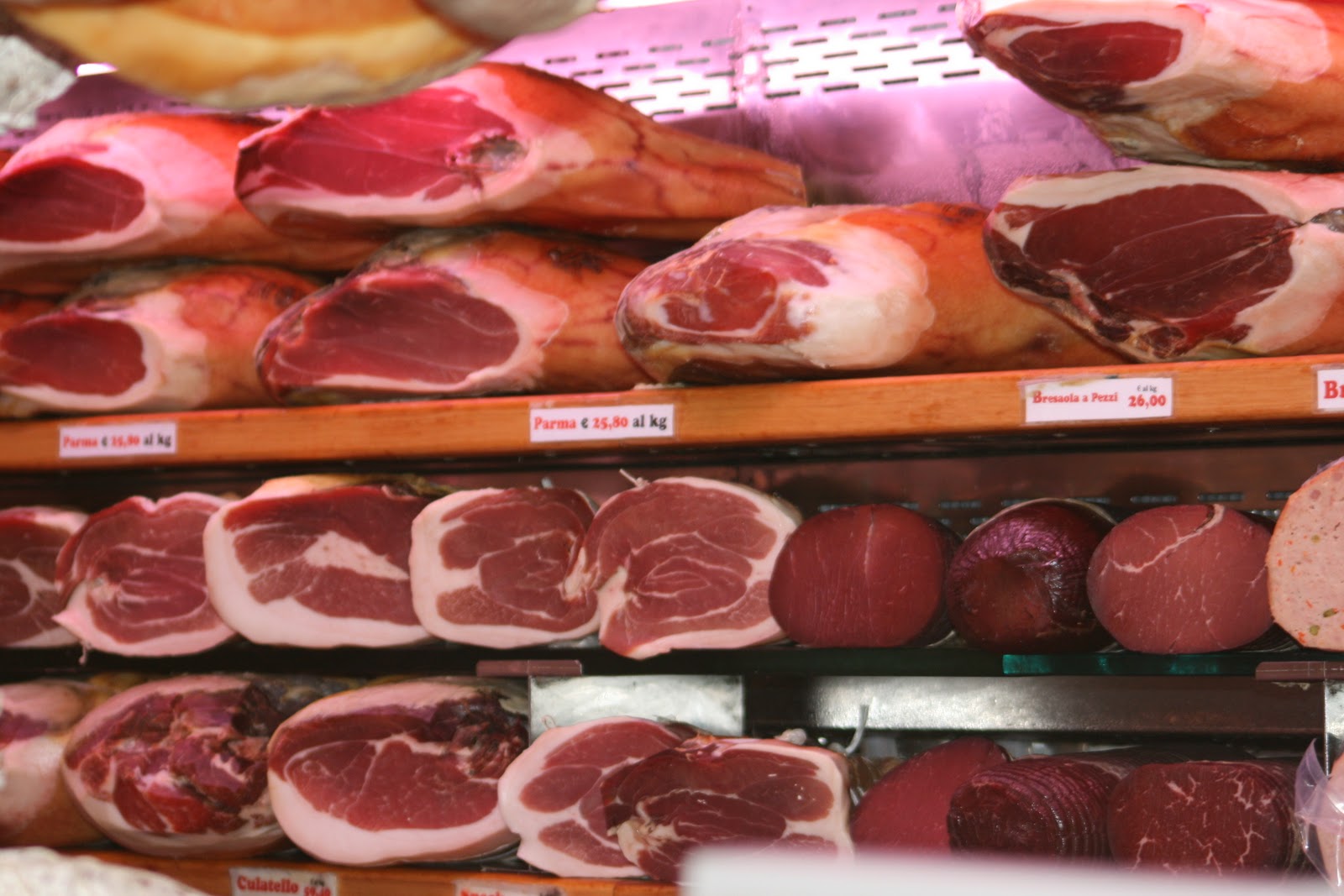 |
| A tiny part of Simoni's ham and salami repertoire |
Simoni are famous for their hams, salamis and cheeses and are one of the few outlets for the highly prized Pasquini mortadella.
 |
| Simoni - one of the shopping delights of Bologna |
After completing a literature degree, Davide went to work as a journalist before trying his hand as a mortadella maker. That is what has really inspired him. In the meantime, he is planning to set up a blog. ‘I am so well placed. I have access to all the best food businesses in the city. I’m sitting on treasure.’ At Christmas, he works extra hours helping out in the family’s other business, a pasta fresca shop on via Murri. He’ll be joined there by siblings and cousins, amongst them an economist, a psychiatrist and a pharmacist. They may not share his passion for sausage making but like him they remain part of the family business, a common feature in Bologna.

See Davide Simoni's guide to the Quadrilatero at http://www.facebook.com/profile.php?id=654742518&sk=wall#!/profile.php?id=100001878283172 (Forgive the interviewer's Italo-American)
Sunday, 11 September 2011
Atti - give us this day our daily bread
 |
| Anna Maria Bonaga - doyenne master baker |
Paolo Atti e Figli - Bakers and Confectioners
via Caprairie 7 and via Drapperie 6
 |
| Francesco Bonaga - inheriting a family tradition |
Francesco claims that they make over 50 different kinds of bread plus dozens of cakes and biscuits. Their crescente, a bit like focaccia but flatter and made with lard as well as oil, is delicious, especially the ones with flecks of mortadella or prosciutto. They are famed for their certosino, a kind of Bolognese Christmas cake packed with dried fruits, and equally for the design of the box it is sold in. Atti also produce a wide range of pasta, especially tortellini, tortellone – the larger variety with ricotta and vegetable fillings - and lasagne. Many of these can be consumed with a glass of wine in the bigger of their two shops. Or taken home in another type of beautifully designed box.
 |
| Everything hand made |
Sunday, 4 September 2011
Let them eat cake
 |
| Surely too beautiful to eat - Caffe e Dolce |
 |
| The display at Pallotti |
- Caffe e Dolce on the corner of Carbonesi and Massimo,
- Colazione a Bianca at the beginning of Santo Stefano,
- FP risto Pallotti, on the corner of Irnerio and Alessandrini, good for breakfast, and very convenient if you’re desperate for a mid-afternoon snack after a visit to the Botanical Gardens.
- Lo Sfizio, via Riva de Reno 100A, has a wonderful range of Bolognese cakes, pastries and biscuits - to buy to take away only.
 |
| Zanarini - where smart babies go for their brioche con crema |
Monday, 29 August 2011
Tagliatelle al ragù di manzo - Shin beef ragù with tagliatelle

An interesting variant on the standard bolognese ragù is this one made with very slow cooked shin of beef. I had thought long and hard about including a wild boar recipe in the book but decided against because it is not readily available. This isn’t wild boar but the long cooking with red wine gives a powerful depth of flavour reminiscent of sauces made with game meat. If you have a slow cooker that would be ideal for this. Cooked on top of the slow there is a danger of the bottom catching and burning. Depending on the size of the chunks of meat, it will need a good six to eight hours of slow cooking. By then, the vegetables, bacon and wine will have combined to make a smooth sauce and the meat will be easily flaked. If you want to be true to the wild boar tradition, you serve it with pappardelle – broad noodles – but if the key word for you is ragù then it must be tagliatelle.
A word about the pasta: I decided to try the experiment of making it entirely by machine and the result was the best ever. I mixed the dough in a Kenwood, and then used the kneading hook on it for ten minutes. As I watched, I saw the consistency changing and when I removed the pasta dough from the mixer bowl it was dry and elastic. After resting it in the fridge for half an hour, I used a pasta machine to roll it out to the second thinnest setting, making sure that I put it through the two broadest settings four or five times. By then it was sublimely silky and easy to work. And I used the Bolognese recipe: 1 egg per 100grams of flour and nothing else.
To follow, we had a dessert made from chestnut puree accompanied by a deep, dark chocolate ice cream that wouldn’t have been out of place in La Sorbetteria or Gianni in Bologna. More of that later.
This recipe makes enough for six. Or you could double the quantities and make an extra portion for freezing.
Ingredients
for the pasta
6 large eggs
600g OO pasta flour
2 teaspoons salt
for the ragù
2 tablespoons olive oil
150g bacon or pancetta
2 onions
2 carrots
2 sticks celery
3 cloves garlic
500g shin of beef
4 bay leaves
2 tablespoons thyme leaves
200ml red wine
500ml beef stock or beef stock cube dissolved in hot water
400g tin of chopped tomatoes
salt and pepper to taste
1 large handful of flat leaved parsley
Method
1. Mix the pasta ingredients in a mixer or food processor then knead for 10 minutes. Wrap in cling film and rest in the fridge.
2. Fry the bacon in the olive oil in a large casserole. Remove and set aside.
3. Finely chop the vegetables and fry slowly until soft and beginning to brown. Remove and set aside.
4. Cut the beef into chunks about 3 or 4 cms in size, having removed surplus fat and gristle. Fry rapidly until browned. Add back the bacon and vegetables, then the wine, driving off the alcohol. Then add the bay leaves, thyme and tomatoes.
5. Bring to barely a simmer, and cook slowly for at least six hours until the meat is very tender.
6. Roll out the pasta, and slice it into tagliatelle.
7. Remove the meat carefully with a slotted spoon. Using two forks, shred it finely, taking care to remove pieces of fat and gristle. Replace the meat, check for seasoning, reheat, adding the parsley finely chopped.
8. Put on the pasta to cook in a large pan of boiling, salted water.
9. Drain the pasta when it is cooked and combine with the ragù. Serve with grated parmesan.
Lunch with the Foodie Bugler herself
_thumb.jpg) |
| Raspberry and almond ice creams with blackberries from the garden |
Monday, 8 August 2011
Gnocchi alle fave con pesto di mandorle – Broad bean gnocchi with almond pesto

Ingredients (serves 4)
for the gnocchi
480g broad bean paste
80g cream cheese
2 egg yolks
2 tbl plain flour
salt and pepper
for the sauce
3 tb l olive oil
8 shallots
50g podded and skinned broad beans
50g grated parmesan
for the pesto
50g parsley
50g grated parmesan
50g sliced almonds
1 garlic clove
4tbl olive oil
salt and pepper
Method
1. Cook the broad beans in plenty of salted water until they are soft.
2. Process the beans with the other gnocchi ingredients. Chill
3. Roll out the gnocchi mixture on a lightly floured board creating a number of long sausages the thickness of your thumb.
4. Flatten the sausages with the back of a fork, and then chop into segments about 2 cms long.
5. Meanwhile make the pesto by processing all the ingredients.
6. Put a pan of water on to boil. Reduce to a simmer. Drop the gnocchi into the water, and leave for three minutes. Strain and lay on a clean tea towel to dry.
7. Heat the olive oil and slowly sauté the shallots until beginning to brown, then add the broad beans and the gnocchi to re-heat.
8. Serve each portion of gnocchi accompanied by the shallots and broad beans and sprinkle with the remaining parmesan. Lay alongside a quenelle-shaped spoonful of pesto.
Tuesday, 2 August 2011
Cucina Bolognese and Me - 2: Virginio Merola, Mayor of Bologna
My ideal dinner companions are people who love good food and enjoy it in the company of others.
Virginio Merola was elected Mayor Bologna for a five year term in May 2011. The candidate of the centre left parties, he won just over 50% of the votes cast. He has committed to tidying up the city centre – long covered in graffiti – and pedestrianising it. Merola, at home with twitter and facebook, has taken a distinctly modern stand on issues like gay marriage. In a photo for the local paper he posed in jeans and jacket surrounded by his cabinet, half of them women. His interview with us shows that he knows his onions when it comes to Bolognese food, even if he does betray his southern origins by plumping for penne all’arrabiata as his favourite dish.
 |
| Virginio Merola: Brought up Bolognese |
1. Who or what has been the biggest influence on your food preferences?
Family and upbringing are the things that have shaped my taste in food. I was born in the South, in the province of Caserta and I was five before we moved to Bologna.
It took me a while to get used to Bolognese food because the flavours were quite different to what I was used to. But in time I’ve come to appreciate Bolognese food.
It took me a while to get used to Bolognese food because the flavours were quite different to what I was used to. But in time I’ve come to appreciate Bolognese food.
2. Why do you think food is so important for the Bolognese?
Food is important because it reflects the culture and tradition of a community. And Bologna, perhaps more markedly than the rest of Italy, has a strong culinary tradition.
It is not just cooking in its strict sense, i.e. how to mix ingredients to best effect, but also how to create them. Take for example tagliatelle al ragù, or spaghetti bolognese as it is known outside Italy. Here we always start by making the pasta – la sfoglia – and then we make the sauce. The traditional skills of the sfogline – the people who make the pasta- are handed on from generation to generation by cookery schools in Bologna specially set up for that purpose.
It is not just cooking in its strict sense, i.e. how to mix ingredients to best effect, but also how to create them. Take for example tagliatelle al ragù, or spaghetti bolognese as it is known outside Italy. Here we always start by making the pasta – la sfoglia – and then we make the sauce. The traditional skills of the sfogline – the people who make the pasta- are handed on from generation to generation by cookery schools in Bologna specially set up for that purpose.
3. As mayor, what would you like to do to improve the impression that visitors have of Bologna?
One of my priorities is to establish a Bologna brand to strengthen our reputation. The aim is to attract more visitors and to raise our profile as a city. We will focus on quality of life issues because we want to improve the sense of well-being of our own citizens as well as our visitors.
4. My favourite meal is...?
5. My ideal dinner companions?
Subscribe to:
Posts (Atom)