Showing posts with label Places to go. Show all posts

Wednesday, 15 June 2011

Learning to make pasta – the proper way

Alessandra Spisne and her daughter Stefania

A morning in La Vecchia Scuola, Alessandra Spisne’s celebrated cookery school (writes Liz). There we met Tim and Janet, two Canadians from Toronto with a passion for pasta. That’s why they are spending five days of their holiday learning how to make pasta.


Breaking the eggs into the flour 'nest'

After donning the school’s t-shirt and yellow cap, they do what they do every day here: they create a 500g nest of flour and break five eggs into it. No olive oil, no semolina (‘that’s not traditional Bolognese’), no extra yolks, just flour and eggs.

Breaking the eggs with a fork, they gradually work in the flour until they have a ball of dough.


Looking for San  Luca
Over at the next table, Massimo, who is doing the three month professional course, is rolling out his 500g and five eggs into a intensely yellow, incredibly thin oval. That’s what Tim and Jackie hope to achieve by the end of the week, a sheet or sfoglio of pasta so delicate that they can see San Luca – the church on the hill overlooking Bologna - through it.

Even though they are only here for a short time, they are taught to professional standards and learn how a real Bolognese kitchen works, with its separate spaces for the pasta maker and the sauce makers. In fact, many restaurants have a pasta workshop in another building where the sfoglina – the pasta maker – toils alone making tagliatelle and gramigna (a kind of curly macaroni that accompanies a sausage sauce), as well as the filled pastas.

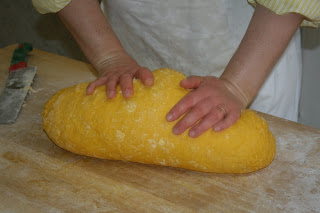
The next step for Tim and Jackie is to knead the dough they have made. For this you need clean dry hands and just a little flour on the rolling board – just how much  you need to knead depends  on the season and the humidity. Today is hot and clammy, tough conditions for apprentice pasta makers.
Kneading the dough
Their task is to make tortellone, pasta filled (in this case) with a mixture of potato, parmesan and finely chopped parsley. Luckily you don’t have to roll the pasta as thin for tortellone as you do for the smaller, finer meat filled tortellini or  for tagliatelle.


As the students cut the sfoglio into small squares, they are told not to waste any of the pasta. ‘You’ve worked hard to make it’, says their teacher Simone, ‘so you want to use every scrap of it’. They work the off cuts into the squares, which makes the pasta thicker but for tortellone this is less critical. Another clever tip is about preparing the potatoes for the filling: they put them once cold through a ricer, skins and all, and what comes out is just the potato. To this they add parmesan, parsley and an egg, and then mix well before putting the stuffing into a piping bag.

End result
Learning to use the piping bag is an art in itself. But once mastered it takes no time to pipe a blob of filling onto every square. Folding over the pasta and then forming the distinctive tortellone shape takes a bit longer. Watching the students grappling with the pasta and the filling you can see why it took Nonna years to perfect hers.

Saturday, 11 June 2011

Surprise meeting

Last night we dined at Locanda del Castello at Palazzo Rossi, Sasso Marconi. And so did Donna and Alistair. So what? Well, funnily enough they were there because they read this blog and decided they liked the sound of the Locanda. And they spotted me from the photo on the blog and introduced themselves. We' d sat at adjacent tables and hearing their accent, I wondered how they'd found out about this slightly off the beaten track restaurant. Anyway, it was an unexpected pleasure to meet some blog followers out of the blue.

In the excitement of the moment, I forgot to ask how they found it. I look forward to reading your comments, Donna and Alastair, about the Locanda and the other places you've tried on your eating tour.

As usual, we loved it. Especially, the lasagnette with aubergine and pesto, the pork chops, and a mille feuille with mascarpone and chocolate (look out for recipe later). The food is classically Bolognese but always with a slight twist of creativity. Incidentally, we got there on the 92 bus, getting off at Pontecchio, walking down the lane to the train station, and crossing over. But we needed a taxi home at 1130.

Tuesday, 7 June 2011

Welcoming eating place with style and good Bolognese food


Perfect place for lunch watching the world go by
 Trattoria La Montonara

Augusto Righi 15


We stumbled on La Montonara and then went back for more. It hardly figures in Trip Advisor but it does rate a mention in the Wallpaper guide to Bologna. What do we like about this small neighbourhood trattoria just off via dell’Indipendenza? Everything: the quaint decor, the service and above all the food.

Run by Filippo Venturi, whose stories about a group of young people in the Bologna of the 80s has just been published, it does simple Bolognese food with a flourish. In a selection of antipasti, the mortadella mousse stood out (see recipe below) as did the hard to get right old stager, crescentine with squacquerone – a local soft cheese that tastes much better than it sounds – and salami. Tagliatelle al’ragu was excellent as were beef carpaccio and a dish of sedanini (pasta) with tomato sauce which was a miracle of simplicity and flavour. The Coteletta Bolognese was finely judged with a tasty piece of veal surmounted by just the right amount of prosciutto and fontina. We all took a spoon to the ravishing and light as air mascarpone pudding. There is a small terrace outside but inside you can still watch the world pass by as well as taki in the fine detail of the decor which consists of toy kitchen sets and ovens, veteran cooking utensils and a set of antique bed heads.

Filippo’s recipe for Mortadella Mousse

enough for 6

Ingredients

250g mascarpone

250g mortadella

1 handful grated parmesan

salt and pepper

a smear balsamic vinegar glaze


Method

1. Cut the mortadella into cubes, then process with the mascarpone. Season to taste.

2. Butter six metal moulds and fill each with the mousse mixture

3. Chill for a couple of hours then unmould by placing each mould for a few seconds in a bowl of very hot water.

4. Alongside each mousse make an artistic smear of balsamic glaze.

Friday, 4 February 2011

La Locanda del Castello

Marcello dall'Aglio chef-patron running a cookery course
‘So this is the Locanda’, said the taxi driver, as we pulled up in the courtyard of the medieval Palazzo de Rossi, near Sasso Marconi, just outside Bologna. ‘I’ve heard a lot about this place’, he said looking around in awe. It’s true the setting is amazing but it’s matched by the food. I’ve been eating here for years and never had a bad meal.

On the current menu my favourites include Spaghetti alla chitarra con gamberi e carciofi al profumo di zafferano – hand made spaghetti with prawns and artichokes in a saffron flavoured sauce - sensational tagliata di manzo – grilled beef – and too many gorgeous desserts including a chocolate pudding that you break open to reveal a molten zabaglione filling or amaretto mousse with a bitter chocolate sauce. And then there is the wine list, with lots of good local wines at reasonable prices as well as a range that takes in the best from every Italian region. Upstairs there are lovely rooms where you can sleep it off and wake up to a delicious breakfast spread including home made marmalade, a rarity in Italy.

Let me declare an interest. Marcello and Giulietta, who run La Locanda, are good friends. On the other hand, don’t just take it from me or the taxi-driver. La Locanda was chosen by the then Italian prime minister, Romani Prodi, to entertain, Tony Blair, the newly elected British prime minister and his family when they holidayed in Italy in 1997.

The cost? Well, a Valentine’s dinner is 45 euro or dinner, bed and breakfast for a couple is 180 euro. They also run evening cookery courses.

Saturday, 8 January 2011

In search of the ultimate…chocolate ice cream

Stefino - a cause for concentration even if it's not chocolate
La Sorbetteria - is this the ultimate?
If you’re ever at a loose end in Bologna, one of the most profitable ways of spending your time is in tracking down the ultimate – in our case – chocolate ice cream. It’s a perfect way of spending a summer’s day, and then, as Margherita Bianchini says, in the winter debating which was the best. Bianchini’s invaluable 101 Things to do in Bologna at least once in your life helpfully pinpoints the gelato giants of the city.

Funivia, now in Piazza Cavour, benefits from the advantage of location. You can buy an ice cream and eat it under the trees in the piazza. There’s even a fountain to wash your hands afterwards. But currently we are torn between Stefino and La Sorbetteria. As always, the ultimate test has to be chocolate ice cream, truly difficult to get right, as Fergus Henderson admits in Nose to Tail Eating where he is driven to appeal for a recipe that works. Stefino’s moro – chocolate with almonds – is a good match for La Sorbetteria’s bitter extra fondant. You could also be tempted by Stefino’s Sicilian cannoli with fresh ricotta or La Sorbetteria’s wonderful array of sweets and chocolates.


Stefino

Via Galliera 49b

Closed: winter


La Sorbetteria Castiglione

Via Castiglione N° 44

Open every day until late

Wednesday, 10 November 2010

Osteria dell’Orsa

At first sight, Orsa seems a bit scruffy. It is certainly not a fine dining experience. But there’s bags of character. You find yourself at a long table, probably sharing with a group of office workers or maybe academics or poets (see below) who are clearly regulars. There’s banter with the waiting staff, discussions and live music some evenings. It’s soon obvious why it’s so busy: excellent food served in a friendly, local osteria in the university quarter of the city. Indeed – the osteria claims – it is here, rather than in the lecture rooms, where the real exchange of creative energy has happened over the years. ‘A cross roads of ideas, of music and performance, a virtual extension of the university, has brought together artists, philosophers, teachers and students, poets and professionals, workers and employers.’ Crumbs.


Anyway, one morning we were passing along the street when we noticed a shop selling pasta. As we looked in we saw in the workshop behind the counter two sfoline making pasta by hand, one of them a man, a rare sight. Sfogline, people who carry on the dwindling tradition of hand-made pasta, are invariably women. Noticing our curiosity, Ornella and Roberto invited us behind the counter to observe at first hand the making of tortellini, explaining that the laboratorio – workshop – was attached to the Osteria dell’Orsa. Our attention was taken by an unusual pasta shape. ‘It’s mezzluna’, Roberto told us, ‘a special order. The filling is artichoke and asparagus.’ He promised to set some aside for us if we came back later for lunch in the Osteria.

So lunch was mezzaluna, followed by grilled steak and chicken. As we were leaving Roberto rushed in from next door with a small parcel of tagliatelle, ‘for you to take home’.

Via Mentana 1/F

40126 – Bologna

Phone 051 231576

Open every day from 12.30 till 1.30 (kitchen closes at half past midnight)

Sunday, 7 November 2010

Teresina

Teresina stands out amongst the places we've eaten in in Bologna. It’s near the top of Oberdan, close to Piazza Maggiore. We ate in a narrow corridor-like room that feels intimate rather than cramped, and it was clear that this is a place that takes food and wine seriously but not in an intimidating way. Service is well-informed and there is an interesting array of pasta, vegetables sott’olio, wine and salumeria to buy to take away. The centre of gravity of the menu is Bolognese but there are also dishes and wines from other regions including Sicily. Excellent tagliatelle al ragu, good spaghetti al pesto and everyone wanted to pick at Annie's roast belly pork. Star of the evening was potato sformato with an asparagus sauce, a simple dish delivered exquisitely. The bill for four of us in June 2009 was euros 115 including euros 30 for drinks.

Next time, we'll try out the dining room at the back that looks as if it has more atmosphere. There’s also an outdoor area for spring and summer. It's worth booking - this place is very popular amongst locals.

Via Guglielmo Oberdan, 4

40126 Bologna (Emilia Romagna), Italy

tel. 051 228985‎

Opening hours 12.30-14.30; 19.30-22.30. Closed Sunday

Photo by Kathleen Hennessy, 2005

Back to Bologna

The new BBC tv series next year featuring Michael Dibdin’s detective Aurelio Zen is bound to reawaken interest in Bologna. So over the coming months I’ll be trying to answer the question, where should we go to eat and what should we do if we’ve got 48 hours in the city.

I’ll be featuring places I like that you see in all the guides – because they deserve to be cited - plus some restaurants and cafes off the beaten track. I’ll also be talking about food producers and some of the wonderful specialist shops in and around Bologna. I can’t guarantee that they will all be as good as I found them on the day you visit, because even top notch restaurants have their off days. But usually I’ve been to eat there because of a local’s recommendation. In any case, the Bolognese restaurant scene is more stable than we are used to. The same people, the same families build up a track record over many years based on the consistency of their food and service. So if I recommend Anna Maria or Serghei I can be reasonably confident that you will find them as I did.

Of course, there are already many recommendations on the blog. Scroll down the left hand size of the screen to Labels, then click on Places to go.

Friday, 30 July 2010

Where to be seen in Bologna - Zanarini

Michele Doria - Mr Zanarini

Michele Doria seems awestruck to find himself the manager of Zanarini. Ask anybody in Bologna which is the city’s premier meeting place and cafe and they are most likely to say Zanarini. After a lifetime in the business, Michele now runs one of Bologna’s most important and long-standing institutions. Since 1928, Bolognese have come here to see and be seen so maintaining the prestige and standing of Zanarini is no small matter.

All day long the square in front of the cafe and the bar inside are busy with (usually) welldressed and turned out locals. The day begins with breakfast, a big Sunday morning tradition in Bologna, then moves through veloce lunch, afternoon tea and then the cafe gears up for the aperitivo. But no dinner because the cafe doesn’t have a licence for hot food.

Italians everywhere enjoy a drink and a snack before dinner, maybe as a break during the early evening passeggiata. But the Bolognese are particularly keen on the practice. Even during the depths of the winter, when a biting wind sweeps in from the Plain of the Po, people can be seen huddled around the doors of bars all over the city, a calice of prosecco in one hand and a cigarette in the other. Aperitivo time is the high point of the day at Zanarini. The free buffet that is your automatic right with a drink is that much more lavish than anywhere else and the service that much more courteous.

Four of us paid €8 each for a share of a bottle of prosecco and more snacks than were wise just before dinner. Michele says that a lot of people skip dinner altogether and just snack away at Zanarini.

Tuesday, 20 July 2010

Bring your own...food at Osteria del Sole

top: the unpreposessing entrance
below: bring your own food


Bring your own for us denotes a restaurant without a licence to sell alcohol. Osteria del Sole, a rough around the edges hostelry in Bologna’s market streets area, is the opposite. You bring the food and they provide the drink. Opened in the 1940s by the family who still run it, you would be hard pressed to say whether it had been redecorated since its first day of trade. Slightly dark and dank, definitely scruffy, Osteria del Sole is also friendly and incredibly appealing.

Entering through an anonymous doorway on Viccolo Ranocchi, Frog Street, your first sight is of a cluster of people around the bar. Behind the bar is a rough and ready but wide selection of wine and prosecco by the bottle or glass (from €2 per glass), grappa, port and beer – the only things served. You won’t get a glass of water, a vodka and tonic, a coffee or a bowl of nuts and that is what makes the osteria such a treat.


Every afternoon and evening the assortment of visibly mended and actively wobbly chairs fill up with people of all ages, in couples, small family groups and big voluble office parties. The long scrubbed wooden tables are quickly covered with bags of bread sticks and wax paper parcels from nearby food shops: pizzette from Atti, or culatello slices and grilled artichokes from Tamborini. You can bring in a Tupperware box of homemade pasta, as long as you don’t forget the cutlery, or a pot of chow mein from the Chinese restaurant further down the street. The atmosphere is convivial; people shuffle up and down the benches to make room for each other or drift outside onto the street for a cigarette.

With the nearby food shops providing an irresistible temptation for a visiting foodie with no access to a kitchen, del Sole provides an equally irresistible solution. Open every day until 10pm, no trip to Bologna should be considered complete without an afternoon or evening whiled away picnicking at one of its long tables, supping from the bar and soaking up some very Bolognese joie de vivre.

Wednesday, 14 July 2010

Olivo, Filippo and Federico - Food, music and pharmaceuticals

Giorgia Zabbini, who knows everyone in Bologna, introduced us to Filippo Russo who set up and runs Olivo. ‘Sometimes you need a change from the trattoria bolognesa with its tortellini and all the classic dishes’, he explained. ‘We take the classic approach and ingredients but give them a modern twist more linked to the Mediterranean.’ An engineer by trade, Filippo also runs an upmarket seafood restaurant in Rimini. ‘At lunchtime we want to offer something affordable, with more elaborate food in the evening.’ A two course lunch with wine, dessert and coffee costs 20 euro.


My tagliolini with baby plum tomatoes and basil was that exemplary Italian dish – perfect ingredients, simply combined with under-stated skill. Ruth is still raving about the seafood pasta she ate there, rigatoni with clams and mussels. The menu changes daily, according to what is in the market.

As well as food, Olivo offers live music in the evening. Right in the heart of the commercial and the university districts, Filippo says it’s like a party at night, with a younger set.


We lunched with Filippo, Giorgia and with Federico Aicardi, song-writer and guitar player. Federico’s day job is running a pharmacy, the Aicardi pharmacy with its gorgeous art nouveau facade, just across the road from Olivo. But he’s probably best known in Bologna as a singer as you can hear at http://www.youtube.com/watch?v=osvo7nteq9c&feature=related 

Olivo
Piazza Aldrovandi 21b
Bologna
+39 051 08 788 72
http://www.ristoranteolivo.com/
closed Sunday lunch and Monday dinner


Olivo's Filippo Lusso

Piazza Aldrovandi

More a wide street than a square, Aldrovandi is often overlooked when it comes to food shopping because it lacks the sheer quantity of top grade specialist shops in the quadrilateral off Piazza Maggiore. But it has its own charms.

The main attraction is the endless parade of fruit and vegetable and cheese stalls, many of them run by south east Asians who know the value of a bargain. Some stalls offer a 1 euro bowl of anything, splendid value when the produce is dazzlingly fresh, as it invariably is in Bologna. There are bars and clothes shops, and at the junction with via San Vitale, a new arrival, Olivo, a new wave restaurant with tables on the street as well as indoors in a jumble of interconnecting rooms.

Monday, 14 June 2010

Vegetables, please


Even the most hardened carnivore or dedicated cheese enthusiast will eventually begin to crave some vegetation, especially in this cheesiest and meatiest of areas. The market in Bologna heaves with a spectacular selection of perfectly ripe and fresh fruits and vegetables. Glistening strawberries, large cultivated varieties and tiny deep red wild berries; luscious cherries; firm asparagus; the reddest tomatoes, all shapes and sizes, clinging to vines; perfectly purple baby artichokes; and tiny courgettes with their delicate yolk coloured flowers. Yet pick your trattorias without care and a visiting tourist could well end up being offered a vegetable diet of little but the odd mixed salad, chipped and roasted potatoes, and perhaps some pale green peas. Here are a  couple of places where you can sample some of the vegetable delights of the market, thoughtfully cooked.

Bistrot 18

Popular with tourists and smart young Bolognese, especially on a sunny lunchtime when pre-booking an outdoor table is a necessity, Bistot 18 offers a good selection of vegetable based dishes. We had fine shavings of raw baby artichokes, simply dressed with olive oil and sea salt, and chunks of larger artichokes, softened and served with a gentle, lemony gremolata - a delicious accompaniment for baked salt cod and black olives. Other contorni offered were braised swiss chard and spinach, borlotti beans and asparagus. The large salads served in deep, multi-coloured coloured bowls are very popular – we tried the ‘Jack’, a generous portion of steamed asparagus, cherry tomatoes and cold roast chicken. The desserts are mostly fresh fruit based. A welcome lunch for a pasta and prosciutto weary palate.

Eat Italy @ Ambasciatore


Is it a book shop? Is it a food shop? Is it a chain of cafes? Well, it’s all of those, spread over three floors in the middle of the market ‘quadrilateral’, the series of streets behind Piazza Maggiore dominated by food shops and eating places. Eat Italy takes the idea of a cafe in a book store a step further. Here you can stop for a coffee, have a light lunch or sample wine. You can do your grocery shopping and maybe also listen to a talk or a short performance.

After a weekend of cucina Bolognese, the top floor wine bar offered a refreshing change. We shared a couscous and roasted vegetable dish and a salad fresh from the market of lambs lettuce, tiny black Ligurian olives, baby plum tomatoes and sautéed spring onions


Friday, 28 May 2010

May weekend in Bologna

Highlights of last weekend in Bologna? Here are the top ones from me and Ruth – you will hear more about these in the coming weeks


1. Discovering the delights of Osteria del Sole, one of the city’s social institutions

2. An aperitivo in the warm glow of the setting sun reflected off the seven churches of Santo Stefano

3. Hanging out with Bolognese eager to share their latest restaurant discoveries and their pride in cucina Bolognese

4. The chic wonders of Eataly, an enticing all in one bookshop, food shop, wine shop and cafes on three floors at Ambasciatore

5. Learning how to make tortelloni and tortellini at the hands of Aurelia, the sfoglina (pasta maker) of Locanda del Castello at Sasso Marconi


6. Tagliolini with zucchini and prawns at Bistro 18, a new wave place or with spaghetti a la chitarra at La Locanda

7. Coffee and a pastry at Zanarini or Gamberini after a hard morning exploring the city’s fleshpots

8. Ice cream from Cremeria Funivia licked up on a shady bench under the trees in Piazza Cavour

9. Shopping for cheese, ham and baby artichokes in the indoor market

10. The stunning  360 degree view of Bologna from the terrace of Hotel Touring

Sunday, 11 April 2010

A restaurant chain with passion

    Marcello Dall'Aglio with son Alan at Osteria Colle Ameno

‘Passion’ was the word Ornella Visentini, the sfoglina at Osteria dell Orsa in Bologna used to describe her attitude to making pasta. That probably typifies the approach of the thousands of artisan food producers that still dominate the Italian High Street. Bologna is largely free of the global food chains we take for granted such as Subway or Tesco. Restaurant chains are also almost unknown – apart from two branches of MacDonalds - most restauranteurs, even the most celebrated, rarely run more than one establishment.

Marcello Dall’Aglio and his partners are something of an exception. Together they run four restaurants and a hotel plus a take-away deli in a busy suburban shopping centre. But his passion for fresh, local, seasonal and artisanal food is undimished as you can discover for yourself at the Locanda del Castello, in the medieval Palazzo Rossi just outside Sasso Marconi.

So how did this come about? An opportunity that was too good to miss is how it began. The proprietor of one of the best regarded local vineyards, Tenuta Bonzara, decided to restore the long abandoned Trattoria San Chierlo next to his cantina where the wine is made. He turned to Marcello Dall’Aglio to take on the job of overseeing the refurbishment and opening it. A similar opportunity presented itself in Borgonuovo, mid-way between Bologna and Sasso Marconi, when a take away and kitchen, Torte e Tortelli, became vacant.

Then came the Hotel Castello, which has twelve beautifully restored rooms above the Locanda del Castello. Not far away, son Alan and his girlfriend have taken over another orphan eatery, l'Osteria Colle Ameno. More recently, Marcello has taken over the management of another restaurant in a local trade union conference centre.

‘Why not’, says Marcello. ‘It gives me something to do and I can offer employment to young people who badly need opportunities these days in Italy.’


Take away display at Torte e Tortelli, Borgo Nuovo

Monday, 19 October 2009

October in Bologna - highlights


Modena
Caffe Concerto, Modena

Brunch it wasn’t. How can you have brunch in Italy when there’s no concept of breakfast? No, this was a high class buffet served from 12-3 at Caffe Concerto in Modena’s Piazza Grande. Self-service buffets in Britain are too often an excuse for off-loading poor food in frightening quantities but in Italy they are invariably done with pride and attention to quality. So, the antipasti included a bufala mozzarella and tomato salad, roast fennel and deep fried aubergine, plates of prosciutto, thinly sliced roast pork and rare roast beef. A lasagne made with mortadella and spinach and ricotta tortelloni were the pasta stars. Then there were fish and meat main courses and a selection of puddings. For €16.5 this was probably the best value meal of the weekend. Afterwards, we took a close look at the romanesque Duomo which faces Caffe Concerto across the Piazza, famous for its idiosyncratic carvings of biblical scenes and a pair of Roman lions.
Modena on a sunny Sunday afternoon in October was charming: strolling families, working off lunch, cyclists, quiet shopping streets and tiny, sleepy squares with older ones dozing on benches whilst children played energetically around them. We took the train there - 30 minutes and €12 return from Bologna.

Trattoria Valsellustra

The drive across the hills south east of Bologna had taken longer than we bargained for so, desperate for lunch and a break, we pulled into a nondescript looking roadside eatery a few kilometres short of Dozza, south west of the hilltop castle town that was our destination. Even before we sat down with the menu, the displays of wine and cheese suggested a place that took itself seriously. From an unusually diverse menu, we chose tagliatelle with white truffle, guinea fowl roasted in cartoccio and a mixed salad. This was one of the most satisfying and well made lunches I can recall probably because of the quality of the ingredients and attention to detail. The tagliatelle was so good I asked if they had a sfolina to make it. ‘Yes, she comes in four times a week’, replied Gianluca Barzagli, the man in charge. The guinea fowl was tender and full of flavour, the moisture and juices conserved in the envelope in which it was cooked. It came with chips crisply fried in olive oil. The mixed salad had no exotic ingredients, simply sliced tomato, rocket, radicchio and lettuce, but with olive oil and a sweet, almost treacly balsamic vinegar it was haute cuisine.

Via Val Sellustra, 16,40020,CASALFIUMANESE Province of Bologna :+39 542- 684073 Closed Thursday

Dozza


Dozza is a fortified town perched on a rocky outcrop with a panoramic view of the Emilia-Romagna plain and dominated by its castle. Inside, deep within the fortification, is a wine shop which claims to stock every significant producer in the region. Colli Bolognesi producers like Tenuta Bonzara, Gaggioli and Vallania were all well represented with more than a dozen varieties of pignoletto, for example. It’s odd that almost none of the dozens of wines on display from Bologna province are available in the UK. So far I’ve tracked down Corte d’Aibo to Adnams in Suffolk.

Regional Wine Store

We had already eaten (see previous entry) and were in any case too late for lunch but Cane, a restaurant with rooms on via 20 settembre is highly recommended and would be high on my list for future visits. Why go back? Well, what the guidebooks don’t say about Dozza is that it has a stunning display of art: paintings on the walls of houses, statues and carvings where you least expect them. Even the water tower – in the modern part of the town on the main road from Imola to Bologna – gets the treatment. Every school of art from early medieval onwards is represented.


Trattoria Meloncello

Melloncello's Torta di Riso

Like most eating places in Bologna, Meloncello is noting to look at from the outside. A narrow three storey building with a sign that suggests the 1920s, it stands alongside the Melloncello arch on via Saragoza at the foot of the two kilometre long portico that snakes its way up to the San Luca Sanctuary. Originally, a staging post, where horses and their drivers were fed and watered, these days it is a classic Bolognese trattoria run by Patrizia Bracci for the last nine years. The menu is like many others in Bologna but with a few specialities for which Melloncello is famous such as meatballs and rabbit with polenta Inside, it is simply furnished and decorated with a terrace for summer dining. We concentrated on exploring the pasta dishes for which the trattoria is renowned. Patrizia recited nine pasta dishes. We couldn’t decide so Patrizia suggested un asaggio, a sampling dish. Between us we tried lasagne verdi, potato gnocchi with sage butter, tagliatelle al ragu, passatelli (a kind of pasta made with breadcrumbs, eggs and cheese), and ricotta and spinach tortellone. The gnocchi were exquisite, tiny, delicate, nutmeggy, cheesy, the lasagne was rich with good pasa, and the passatelli were memorable in a deeply flavoured chicken broth. For secondi we ordered Melloncello’s famous meatballs, friggione (stewed onion and tomato) and roast, stuffed onions and tomatoes. As usual there was scarcely room for dessert but we sampled torta di riso (so-so) and an amaretto pudding (a bit like a crème caramel but more interesting).We drank two bottles of pignoletto and the five of us paid €149.

Best dish of the weekend

This is tough. The gnocchi at Melloncello, the tortellini at Godot Wine Bar, the guinea fowl at Valsellucro, the mortadella lasagne at Caffe Concerto: these all rate highly. But ultimately, the prize for best dish of the weekend goes to the Locanda del Castello at Palazzo Rosso, Sasso Marconi for spaghetti alla chitarra with courgettes and prawns. Marcello dall’Aglio says that the key to the dish is the prawn stock and the saffron which holds everything together. Everything was just right and perfectly balanced: the tiny cubes of grilled courgette and the plump juicy prawns. Is it Bolognese – yes, of course, fresh water fish have long been a part of the tradition. And to complete the pleasure, the spaghetti came with a glass of Tenuta Bonzara’s reserve merlot, a revelation if you are underwhelmed by merlot like the two guys in Sideways.

Sunday, 4 October 2009

Trattoria Danio - friendly neighbourhood lunch stop

Danio is a traditional, friendly, value for money, neighbourhood trattoria. Bologna retains the Italian tradition of the proper sit up lunch - 3 courses with bread and even a little wine. For those who cannot get home for their lunch break the local trattoria still provides a home from home and this is clearly a place where local office workers and labourers come.
Founded in 1937 but bought by the Gelfusa family in 1957, Danio has become a Bolognese institution that prides itself on hand made pasta. Fixed price menus can be a lottery but for €11.50 (April 2009) we ate well. We had tagliatelle al romagnolo and penne all’ arrabiata followed by roast chicken and steak. The pasta, in particular, was very good, and so was the atmosphere. Everyone seems to know everyone. Bustling around was an old geezer who was clearly the boss.


Lino - the boss...dishwasher

Or so we thought. Later when we were interviewing Fabio Gelfusa, who with his brother and father, runs the place, we discovered that Lino is actually the dishwasher. ‘But he’s always worked here, and being here keeps him busy, even if he’s always in the way’, Fabio explains.
Go at lunchtime for the fixed price menus – there is also one at €7.5 – or in the evening for a more extensive menu including crescentine.


Franco, Fabio and Rocca Gelfusa
Via San Felice, 50
40122 Bologna
051 555 202
Open from 12.00 pm to 3.00 pm and from 7.00 pm to 12.00 am.

Thursday, 10 September 2009

The vineyard

Tenuta Bonzara is in a stunning position high above Bologna, in Monte San Pietro. The vineyard teeters sharply downhill, planted with a mixture of native and foreign vines. So there is barbera as well as cabernet sauvignon and merlot; sauvignon as well as pgnoletto. The cantina, where the wine is made, is all stainless steel with automatic bottling and labelling machines. I went to visit the vineyard with Marcello dall'Aglio, from La Locanda del Castello, who rates their wine and now runs the trattoria there.

Of all the Colli Bolognese producers, Lambertini has established a global toehold with his Bonzarone, an oak aged cabernet sauvignon that scored 94 out of 100 in a Wine Spectator review. In fact, it’s one of the only two Colli Bolognesi producers recognised by the respected US magazine, the other being Lambertini’s neighbour, Vallania. We taste a young barbera still in barrel, a new venture for the vineyard. There’s none of the thinness and sharpness I’m afraid I associate with this grape. Not a classic maybe but with the prospect of being on a par with many


Checking the labels – a gift for quality
a wine from Piedmont, the traditional home of barbera - although nobody outside Italy will ever know it unless something is done to improve the marketing of Colli Bolognesi.
It is a sad fact that the best wine growing region(s) does not coincide with the best food region in Italy. But wines from the Bolognese hills deserve better than to be totally unknown outside Italy - unless you count Lambrusco.

Tenuta Bonzara’s sparkling wine ready for packaging
Mario, the cantina manager, is determined to show off his best. Marcello thinks that the sauvignon blanc is ‘terrific’. The nose is powerful with fruit, like a southern hemisphere wine, and it has a great finish, like a French wine. I try pignoletto, a personal favourite. Light and subtle, it makes a perfect aperitif, especially in the frizzante (petillant) style.

We cannot escape without a tour of the vineyard. We hurtle down the hillside in Mario’s well-used Fiat Panda to the point where old vines and new vines meet. The new ones are planted much closer together, 80centimetres instead of 1.5 metres; the theory is that denser planting produces better grapes and less foliage. Quality is the mantra of the best producers like Lambertini but Italy is still the world’s biggest bulk exporter.

Mario and Marcello compare grape varieties

On a fine day, you can see for yourself. Book into the Trattoria San Chierlo for lunch and then visit the Cantina at Tenuta Bonzara, a hundred metres away.


Trattoria di San Chierlo
Via S. Chierlo, 13/A -
40050 Monte San Pietro (BO)
Tel +39 051.6768270 -
Email: info@trattoriasanchierlo.it


Tenuta Bonzara
http://www.bonzara.com/eng/trattoria_bologna.php

Wednesday, 2 September 2009

Making egg pasta


If you like cucina Bolognese, you will want to make your own pasta. Once you get the hang of it, you can do the whole thing in less than half an hour. Below, we explain how it’s done. All you need is a board, a rolling pin, some flour and eggs.

Egg pasta is not exclusive to Bolognese cookery but it is essential to it in a way that is not true of the other places where it is also popular, such as Venice. It is used to make the noodles or tagliatelle which accompany the famous Bolognese meat sauce, the ragù. It is also used to make stuffed pasta, especially tortellini, the little meat-filled parcels that are the highlight of Christmas Eve supper and celebrations such as weddings and communions. The meatless versions are called tortelloni or tortelli or tortellaci. Egg pasta is also used to make the small sheets of pasta which go into that other Bolognese must-eat, lasagne.

If you’re pushed for time, and decide to buy fresh egg pasta from a supermarket or deli, don’t make the mistake of overcooking it. On the other hand, if you are making lasagne, and using bought pasta, don’t make the mistake of not pre-cooking it at all (whatever it says on the label). It will not cook properly and taste raw when it’s served. Parboil the lasagne sheets for two minutes and drain them well before laying them on a tea-cloth until you are ready to make the lasagne.

Stuffed Pasta

Almost every city in north and central Italy has its own version of stuffed pasta. Ravioli, agnolotti, tortellone are variations on the same theme, using different shaped or sized envelopes and a variety of fillings.

The pasta can also be coloured and flavoured with nettles, spinach or tomato. Some of these are more robust than tortellini and can cope with a strong partner such as a meat sauce or simply cream and parmesan. Although the artisan tradition is giving way to machine made pasta, there are still places where you can see tagliatelle and tortellini being made. Often there is a special outlet, with a workshop called a laboratorio where pasta is made. And presiding over it is the sfoglina, or pasta-maker, so called because they make a pasta sheet or foglio.

Popularly invested with semi-magical powers, the sfogline carry on the skills of their trade from generation to generation. The wrinkled old lady who used to sit at the entrance to the trattoria, patiently and expertly making stuffed pasta, like the one I remember in Lagune, up in the hills near Sasso Marconi, is no more, alas, and most people these days buy their pasta from their favourite pasticceria (which also sells pastries and sweets).

One place that still has a sfoglina is Anna Maria, a restaurant in the centre of Bologna, a favourite with audiences, performers and the orchestra from the Teatro Comunale nearby.

The celebrated Anna Maria in full flow

Just down the street, behind an anonymous shop front, is the lab. where Nicoletta Bussolari makes egg pasta for the restaurant. She tells us, 'It's a creative thing. I feel a lot of passion for making pasta. Very simple, just eggs and flour'.

Nicoletta with a foglio
Just around the corner is another laboratorio run by Osteria dell Orsa where you can buy tagliatelle, tortellini and tortelloni.


Orsa: Scruffy entrance, delectable food

We watched as Roberto Gasperini– a rare male sfoglino – and Ornella Visentini rapidly made a batch of tortellini. ‘And what is the filling for this half-moon shaped pasta?, we wanted to know. ‘Ah, that’s a special one, just for the Osteria’, replied Roberto, and he paused, ‘But if you come back at lunchtime I’ll make sure there’s some set aside for you.’ And he did.

Roberto and Ornella: Orsa's Sfogline


La Locanda del Castello at Palazzo de Rossi also has a laboratorio, behind their takeaway deli, Torte e Tortelli, just up the road in Borgonuovo. This large catering kitchen is equipped with a giant mechanical pasta roller which comes into its own for large scale events like weddings. But most of the time, their sfoglina works with the same equipment as all the others: a matarello, a metre long rolling pin, a rolling table, strong arms and a good eye.

Egg pasta – how the experts make it

Nicoletta makes the whole process look very easy. First, you measure out the flour, which must be pasta flour, marked OO on the package. The rule of thumb is 100g of pasta per person, and one medium sized egg per 100g. If you make the pasta on a board, make the flour into a volcano shape with a crater in the centre.
Crack the eggs into it and mix together with a fork or your hands, as she does, until you have created a large cylinder of dough.


Above: making the flour volcano. Right: amalgamating flour and eggs
If the eggs are corn-fed, they will lend the pasta that distinctive and appealing yellowness. (Hopefully, the colour will be natural rather than an additive.)


Kneading the dough
Now, knead the pasta on a floured board by pushing it away from you with the heel of your palms, folding it over, and pushing it away again, until the pasta loses its stickiness and becomes elastic. You can do all this using a food mixer. Don’t begrudge this part of the process; it produces pasta that is more easily worked and doesn’t stick. Then, wrap it in cling film and leave it to rest for an hour.

Now you roll it out. Sfogline use a matarello but you can use an ordinary pastry rolling pin. In Marcello dall’Aglio’s lab. at Borgonuovo where the take away food is made, they have an immense rolling machine which is less romantic but very fast for large quantities. Or you can use a domestic pasta machine. Don’t skimp on the number of times you feed the pasta through the machine. Three or four times at each width setting will produce smoother, silkier pasta. Once the pasta is rolled, it can be sliced to make tagliatelle (usually 6-8mm wide), or the broader pappardelle, or cut up into rectangles for lasagne or stuffed. If you are making stuffed pasta, don’t let it go dry, otherwise it will be difficult to seal the edges together.

Sunday, 23 August 2009

Quercia – a rural bolthole near Bologna


Playing ball between courses

On a warm Saturday in May the restaurant is full of families having lunch. Between courses, father play football with their children in the garden, or taking them to visit the farm’s menagerie of donkeys, pigs, sheep and ponies, whilst the women sit on the terrace chatting. It feels like home, and that is the open secret of Quercia, a small country hotel perched on the side of a valley not far from Bologna.


Andrea, Federica and Paola

Paola and Alfredo decided to swap city life for a rural existence in the 1980s, a time when most people were heading in the opposite direction. Realistic about the rigours of making a living off the land, they had a clear vision of a place in the country not too far from the city where families, friends or couples could come and play for a few days. Another generation, son Andrea and his partner, Federica, have joined the enterprise, waiting table or looking after the guestrooms. There is also Gino and Ione, Paola’s parents, now too elderly to help in the running but curious to meet the guests, and invariably at the weekend, Paola’s brother, Mauro, who swaps an office job – he works for the cooperative movement – for a chef’s outfit.


In the beginning there was a simple restaurant, where the family lived on the premises, as they set about creating a small farm with fruit trees, a vineyard, a vegetable garden plus a few animals. Later they converted an old barn into rooms. Gradually, they created a reputation for good food, made whenever possible from their own produce, served in a relaxing environment, where visitors might enjoy real family hospitality.

Twenty years ago scarcely anyone had heard of agriturismi, or bed and breakfast on a farm, but now there are another dozen in Bologna province and hundreds throughout Italy. Not all are as welcoming or as pleasing to all the senses as Quercia, named after the oak trees that march up the gentle hillside towards the farm.
The house is bedecked with a collection of old roses created by Federica, and everywhere there of signs of people who know and care about the quality of the environment. The guestrooms are individually decorated and the vineyard is well maintained.
The menu was announced by Andrea in Italian and English. First, a selection of pastas preceded by a delicious potato blini with a delicate salami filling. Home made macaroni with asparagus and bacon came with tortelloni stuffed with ricotta and hazelnuts, tagliatelle al ragu (naturally) and the star of the show, ravioli made with Jerusalem artichokes. With the assagi di primi we drank Alfredo’s pertly aromatic riesling. Then came a series of main courses, including beef and rabbit, accompanied by a generous and fruity cabernet sauvignon. Desserts were strawberries with white chcoloate ice cream or zabaglione.

After lunch, we walked across the field and down the lane to the village to visit the parish church, with its Romanesque cloister and bell tower. It stands in the valley of the Samoggia , one of several small rivers that flow towards Bologna to join the Reno on its journey to the Adriatic, finally forming part of the sluggish Po.

As we returned, the guests were beginning to depart, after lengthy exchanges of kisses and embraces. There was no pressure to leave. But we did, driving up corkscrew bends and across ridges and valleys en route to Bologna.

We broke the return journey high up in the hills, to visit the Abbazia di Monteveglio, where there is a medieval village built around a monastery.

Agriturismo Quercia

Via Mulino, 90940050 Castello di Serravalle (BO)
Tel.: 051 6703218
Fax: 051 6703218
Sito web: http://www.italia-agritur.it/agriturismo/emilia_romagna/bologna/fattoria_quercia/redir?url=http://www.fattoriaquercia.it
Responsabile: Paola Cardelli