Showing posts with label People. Show all posts

Tuesday, 13 December 2011

Mortadella - uniquely Bolognese

‘I can’t say it’s better than the others. All I can say is that a lot of people prefer it  to the others.’
 - Ennio Pasquini
Pasquini is a no nonsense,  bear of a man who meets us with his arms folded and a look of undisguised scepticism. In his late 70’s, after half a century,  he is  still very much in charge of the business,  very conscious of its importance.
 Besides, time is money. But he agrees to show us around.
Ennio Pasquini - traditional  hand made mortadella
Bologna is known the world over for a cooked sausage, the mortadella, that has its origins in the 16th century. There are many firms around Bologna entitled to stamp their mortadella IGP, as a European protected product,  but Pasquini is the only one within the city walls. Moreover, it is the only truly artisanal producer, with much of the work done by hand, especially of the salame rosa variant. Including the boss, there are just seven workers. The output is a tiny 20 quintals a week, or 2000 kilos.  Not a lot compared with the 37 million kilos produced in 2006 by the 30 companies that make up the Bologna Mortadella Consortium.
 It is highly prized in Bologna as an aperitivo snack, as part of a plate of finely sliced salami and as an ingredient in the filling for tortellini.  We also liked the mortadella mousse served at Trattoria La Montanara.

Mortadella mousse
Unlike other salamis, it is cooked rather than cured.  This mortadella is not to be confused with the pink, slimy chopped ham impersonators to be found in many supermarkets, especially in America. Nor does it contain the pistachios or peppercorns that some other varieties contain.
‘I decided to carry on the artisan tradition because I wanted to keep control of quality’, Pasquini explains. ‘It’s like if you had a baby, you wouldn’t want to hand it over to a nursery, you would want to bring it up yourself. Well, for me it’s the same with mortadella. ‘
He takes us into the cooling room where yesterday’s production is suspended from a large frame. ‘In some ways, it’s very easy to make. But it is also quite difficult to get right because it’s a real team effort. Yes, a team sport, not a cycle sprint.  It’s like a jigsaw, every part of it has to be precision made or it won’t fit together.’
There’s a ready market for the real thing but Pasquini controls rigorously whom he allows to sell it. Simoni, the salami, ham and cheese shop in the Quadrilateral is one of the few privileged. The shelves there empty at Christmas, Davide Simoni, tells us, because that’s when mortadella is given as a present and when much of it finds its way into traditional seasonal dishes such as  tortellini, a must for many Bolognese families on Christmas day.


Sunday, 16 October 2011

The best tagliatelle in Bologna?

The sfoglina – or pasta maker – is the person who makes a restaurant’s   reputation in Bologna. And a little known place just outside the city has now become the tagliatelle hot spot after chef Beniamino Baleottti  - that's him in the centre in the blue t-shirt - won the prize of sfoglino d’oro at the recent international competition in Bologna’s Sala Borsa in Piazza Maggiore. Agriturismo Le Ginestre at Pianoro, just by the motorway’s Sasso Marconi entrance, is run by an ex-mountaineer, his wife and their seven off-spring including Beniamino. Their organic farm produces ham and salami, fruit and vegetables. As well as dinner, bed and breakfast they offer cookery courses taught, naturally, by the new sfoglino d’oro.
Contact them at www.agrileginestre.it

Monday, 19 September 2011

Shopping in Bologna: Davide Simoni – new generation family business

Davide Simoni - champion of mortadella

Davide Simoni’s ambition is to make the best quality artisan salami. He’s spent two years learning the ropes on the factory floor at Ennio Pasquini’s mortadella laboratorio.Now he’s back at the family shop, Simoni, learning to run one of the landmark family businesses in the Quadrilatero.

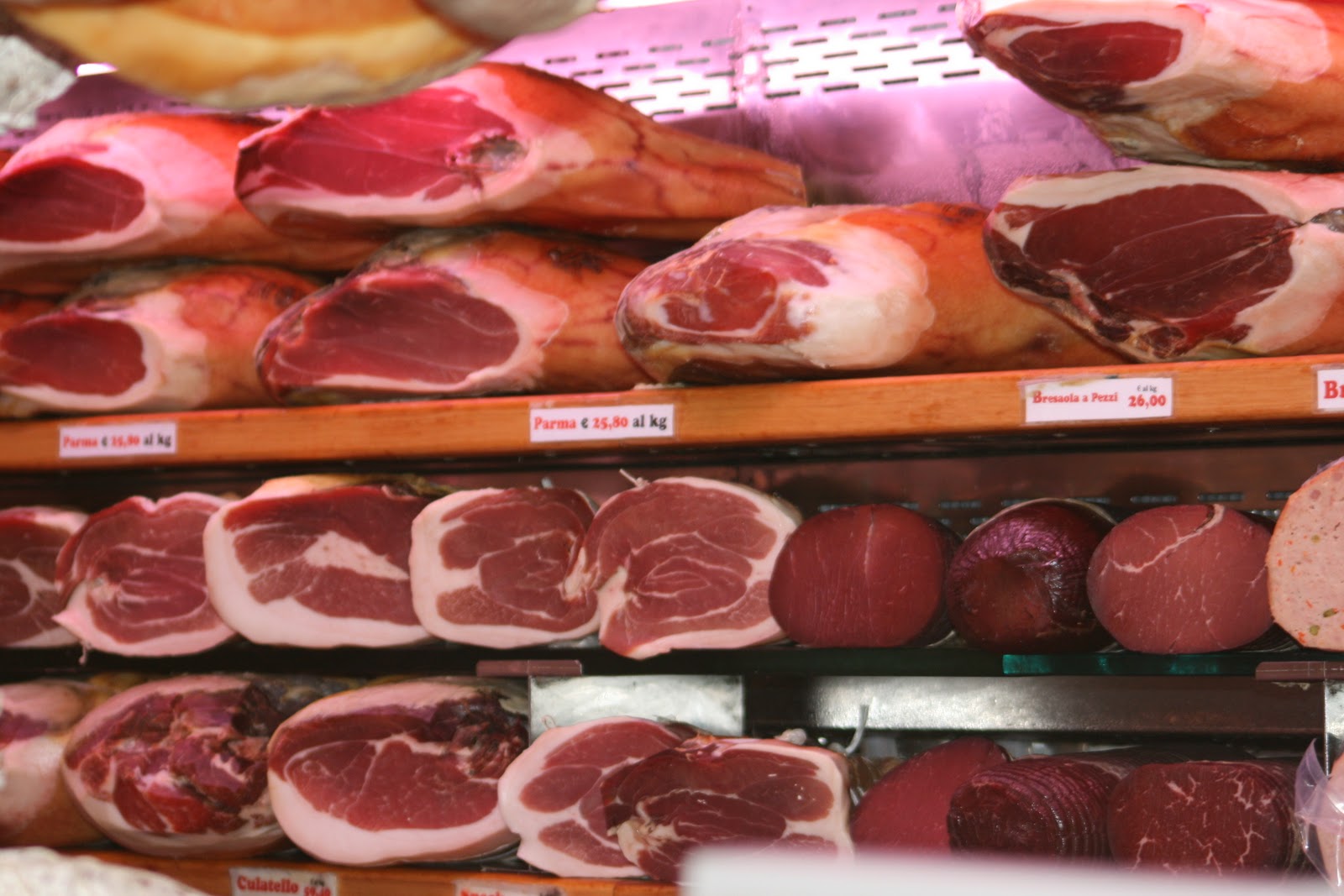
A tiny part of Simoni's ham and salami repertoire

Simoni are famous for their hams, salamis and cheeses and are one of the few  outlets for the highly prized Pasquini mortadella.
Simoni - one of the shopping delights of Bologna


After completing a literature degree, Davide went to work as a journalist before trying his hand as a mortadella maker. That is what has really inspired him. In the meantime, he is planning to set up a blog. ‘I am so well placed. I have access to all the best food businesses in the city. I’m sitting on treasure.’ At Christmas, he works extra hours helping out in the family’s other business, a pasta fresca shop on via Murri. He’ll be joined there by siblings and cousins, amongst them an economist, a psychiatrist and a pharmacist. They may not share his passion for sausage making but like him they remain part of the family business, a common feature in Bologna.

See Davide Simoni's guide to the Quadrilatero at http://www.facebook.com/profile.php?id=654742518&sk=wall#!/profile.php?id=100001878283172 (Forgive the interviewer's Italo-American)

Tuesday, 2 August 2011

Cucina Bolognese and Me - 2: Virginio Merola, Mayor of Bologna

 My ideal dinner companions are people who love good food and enjoy it in the company of others.


Virginio Merola was elected Mayor Bologna for a five year term in May 2011. The candidate of the centre left parties, he won just over 50% of the votes cast. He has committed to tidying up the city centre – long covered in graffiti – and pedestrianising it.  Merola, at home with twitter and facebook, has taken a distinctly modern stand on issues like gay marriage. In a photo for the local paper he posed in jeans and jacket surrounded by his cabinet, half of them women. His interview with us shows that he knows his onions when it comes to Bolognese food, even if he does betray his southern origins by plumping for penne all’arrabiata as his favourite dish.
Virginio Merola: Brought up Bolognese


1. Who or what has been the biggest influence on your food preferences?

Family and upbringing are the things that have shaped my taste in food.  I was born in the South, in the province of Caserta and I was five before we moved to Bologna.
It took me a while  to get used to Bolognese food  because the flavours were quite different to what I was used to. But in time I’ve come to appreciate Bolognese food.


2. Why do you think food is so important for the Bolognese?

Food is important because it reflects the culture and tradition of a community. And Bologna, perhaps more markedly than the rest of Italy, has a strong culinary tradition.
It is not just cooking in its strict sense, i.e. how to mix ingredients to best effect, but also how to create them. Take for example  tagliatelle al ragù, or spaghetti bolognese as it is known outside Italy. Here we always start by making the pasta – la sfoglia – and then we make the sauce. The traditional skills of the sfogline – the people who make the pasta- are handed on from generation to generation by cookery schools in Bologna specially set up for that purpose.  


3. As mayor, what would you like to do to improve the impression that visitors have of Bologna?

One of my priorities is to establish a Bologna brand to strengthen our reputation. The aim is to attract more visitors and to raise our profile as a city. We will focus on quality of life issues because we want to improve the sense of well-being of our own citizens as well as our visitors.

4. My favourite meal is...?

My favorite dish is penne all'arrabbiata


5. My ideal dinner companions?

My ideal dinner companions are people who love good food and enjoy it in the company of  others.


Sunday, 26 June 2011

Federico Aicardi – food loving musician and pharmacist

Federico Aicardi - singing pharmicist

The day job of Federico Aicardi,  a singer song-writer with a growing reputation in Italy,   is running a pharmacy in Bologna city centre. The previous time we met he supplied me with a few sachets of his famous Aicardi baking powder which I used to explosive effect to bake a giant focaccia. This time we met for lunch across the road at Olivo. Federico knows everyone including another diner who he introduced as one of the most famous singers in Italy.
I began by asking him about his earliest   memories of being brought up in a Bolognese household.  ‘I was very small and it was Christmas, and my grandmother and my mother and all the women were gathered around the big kitchen table that I used to play with my soldiers on. They were all making tortellini as if the whole of Bologna was coming to dinner.’
Apart from tortellini and lasagne, Federico has fond memories of those other Bolognese winter classics, ciambelli, a ring shaped cake and certosino, the richly fruited Christmas cake. But from holidays in the mountains in the north east he picked up a liking for polenta, and from trips to the seaside, he came to love piadina, a flatbread that is traditionally eaten filled with spinach or with mozzarella.
'It's all they ever talk about.'
Federico married into a food loving family. ‘It’s all they ever talk about when we get together – their last great meal or a favourite dish’.  He promised to send me his wife’s recipe for roast guinea fowl. But why is that the Bolognese love to talk about food, I asked.
‘Well, it is a centuries old tradition here,  food culture was an integral part of the every day experience in the big houses that once  ruled the city. Poets would write about food and wine. We’ve always admired the skills of great cooks, and women have always been prized for their skill in the kitchen. Nowadays, our love of food goes along with  our pleasure in socialising. We love to get together to eat and talk (as I’d noticed)’.
But is that any different from anywhere else?
‘People still stop for lunch in Bologna whether they’re lawyers or factory workers. They don’t in Milan. They just have a quick sandwich there. Bologna is known throughout Italy for the quality of the food you can eat and for the reputation of its university, whereas Rome is known for being the centre of government and for its monuments and Milan for fashion and the pace of life’.
We moved on to talk about favourite places for aperitivi. ‘Somewhere very traditional is the Osteria Olindo Faccioli or Drogheria Calzolari. Young people prefer the Nu Lounge in San Petronio’. And eating out? ‘ I like della Santa and Cesare Maretti’s place in via Senzanome. I also like da Vito for the atmosphere and the fact that you’re likely to be rubbing shoulders with writers and artists’.
But what about his dislikes. ‘The worst meal I’ve ever eaten was in Santa Barbara, in California, fettucine alfredo, a dish that doesn’t exist here. The pasta was overcooked and swamped in water and cream. Ugh. I can’t stand the fact that MacDonalds is right in the centre of Bologna opposite the statue of Neptune. I’ve got nothing against America or American food but this is sacrilege. Oh, and I can’t stand mostarda di cremona’. At this point I explained the well known English concept of Marmite food – you either love it or hate it.
Finally, his ideal dining companions?  Every year, he gets together with 25 of his mates from high school for a meal. ‘This year it was at Anna Maria’s. I don’t know where we’ll go next year, but we are a big bunch of foodies, as you might expect’.


Sunday, 19 June 2011

Highlights of a month in Bologna?

Piazza Maggiore - late night
Hard to choose. But top of the list are the city itself, with its never ending vistas of medieval buildings and the porticos, fascinating shops and workshops, and the people who we have met who have been so generous with their time. Above all,

• Gianni at Vicolo Colombina and their gorgeous recipe for lasagne with a guinea fowl ragu

• Giacomo the chef at Trattoria della Santa and his recipe for tortellone

• excellent recommendations for places to eat from Giorgia Zabbini, Mimy Tavormina and Davide, the chef-tutor at the Cookery School on via Pratello

Mimy Tavormina - local where to eat specialist

• charming memories of Bolognese food from Massimo Maracci and Federico Aicardi

• Alessandra Spisne and the team at La Vecchia Scuola for their enthusiasm and hospitality

• Marcello dall’Aglio at Locanda del Castello who provided us with one of our most memorable dinners (and where we ran into Donna and Alistair, two of our blog followers)

• Davide Simoni who took time out to introduce us to Pasquini, the only artisan mortadella maker left in Bologna

• the Bergonzis at Al Vedel and Podere Cadassa near Parma who put on a special display of culatello production just for us and Marcello

• Trattorie La Montonara, Olivo and Leonida for beautiful food and lovely recipes

• two simple ideas: Almond pesto at Eataly and zuccine pesto at Al Vedel.


More of these on the blog over the coming weeks – and also in the forthcoming book.


Bologna's porticos: feast for the eye, protection from the elements

Thursday, 11 November 2010

Cucina Bolognese and me: a New Series

We talk to well-known and less well-known Bolognesi about the city and its food and what it means to them.

Starting with Marcella Puppini of the Puppini Sisters

Marcella Puppini, the founder of the famous Puppini Sisters, has lived in London since the 80s but she was born in Bologna where her parents live and she goes back there a lot. Her career as a performer takes her all over the world so she’s had plenty of opportunities to compare cucina Bolognese with other cooking styles, including in other parts of Italy.

Christmas with the Puppini Sisters is their new album. You can hear their classic rendition of I will survive at http://www.thepuppinisisters.com/2010/09/the-puppini-sisters-i-will-survive/

We met over tea at Maison Bertaux, Soho’s venerable tea shop, on a wet and windy late October day.

1. Single biggest influence on me was watching La Traviata on tv when I was 12. The theatricality, the spectacle, the flamboyance of it decided it for me, I wanted to become a musician and performer. When I was older I left for London to study music, and apart from a flirtation with fashion, that’s what I’ve done ever since, singing and performing in London.

2. My earliest memory of eating Bolognese was when I was three and my mum made me boiled calves brains. I’ve always been able to eat anything, tongue, brawn, anything.

3. My biggest food influence was my grandmother and later my mum. I remember Sunday lunch at my grandmother’s. She was extremely traditional. We would have lasagne and roast chicken. Or sometimes it would be tagliatelle al ragu. My mother, by contrast, has always been experimental in her cooking, trying to replicate Indian or Chinese food she’s eaten out, and it was very good. If she’d been born later she might have been able to follow her longing to become an artist so in a way her cooking is a way of expressing her flair and creativity.

4. My favourite family recipe is lasagne as made by my grandmother. She made her own pasta, the ragu was very meaty and there was plenty of béchamel. I can’t stand the way they make lasagne over here. The pasta is too thick and it’s not made properly with spinach or nettles (ortica), there’s too much tomato in the sauce, which makes it acidic and heavy, and there’s not enough béchamel sauce.

5. The reason eating is so important for the Bolognese is because it’s associated with spending time with the people you love, your family, and it’s a feeling that is instilled into you from when you are very small. Italian families do get together for lunch on Sunday and the more food there is the longer you spend together at the table. It’s a basic thing in Italy, this sense of conviviality: you can never be somebody’s guest for more than five minutes before you are offered something to eat or drink.

6. Best place in Bologna for an aperitivo is Il Calice or Zanarini. I also love a glass of wine and a snack at Tamburini.

7. I can’t bear to eat bland or creamy food. French food sometimes is too rich and there’s a tendency to add cream to dishes that don’t need it in Italian restaurants abroad. I’m also not keen on fusion food that sometimes tastes of nothing because there’s too many ingredients. The thing about Italian food, from any region, is is simplicity; it all depends on just a few ingredients. Spago is a good Italian restaurant in London but there aren’t many. I prefer a good curry. Or a boiled calf’s head, then I’m in heaven.

8. When I’m in Bologna my favourite place to eat is home, without any doubt. When I was younger I would meet my dad after school at the tennis club cafe in the Giardino Margarita and the food there was good and straightforward. The trouble with restaurant food in Bologna is the lack of vegetables which isn’t true when you eat at home. When I was a teenager I would invite my friends home for lunch and tea which was good because we had a big kitchen and an open fire.

9. My worst meal – and I have a few because as a musician you’re always travelling – was in Bethnal Green, in London, at an Indian place where I had a vindaloo that was a wall of heat without any flavour.

10. My ideal dinner companions are people who can distinguish between good and bad cooking and like something a bit out of the ordinary. I like cooking for the other Puppini Sisters. They appreciate my experimental approach – like, dill and sweet potatoes. I like people who appreciate the artistry in cooking. That’s why I love Japanese.

11. London or Bologna? Definitely Bologna for eating but there’s such a great variety of choices in London and eating out has improved a lot since I first came here.

12. My final supper would consist of a Christmas roast dinner, my mother’s roast pork, or maybe her Christmas Eve dinner of fish, or probably both of them if I were facing execution. A few months ago everyone though I really was facing death. I was in Bologna with suspected swine fever, and the only thing I could eat in hospital was mashed potato and it was lovely. It turned out I was suffering from a nasty strain of flu.

Friday, 30 July 2010

Where to be seen in Bologna - Zanarini

Michele Doria - Mr Zanarini

Michele Doria seems awestruck to find himself the manager of Zanarini. Ask anybody in Bologna which is the city’s premier meeting place and cafe and they are most likely to say Zanarini. After a lifetime in the business, Michele now runs one of Bologna’s most important and long-standing institutions. Since 1928, Bolognese have come here to see and be seen so maintaining the prestige and standing of Zanarini is no small matter.

All day long the square in front of the cafe and the bar inside are busy with (usually) welldressed and turned out locals. The day begins with breakfast, a big Sunday morning tradition in Bologna, then moves through veloce lunch, afternoon tea and then the cafe gears up for the aperitivo. But no dinner because the cafe doesn’t have a licence for hot food.

Italians everywhere enjoy a drink and a snack before dinner, maybe as a break during the early evening passeggiata. But the Bolognese are particularly keen on the practice. Even during the depths of the winter, when a biting wind sweeps in from the Plain of the Po, people can be seen huddled around the doors of bars all over the city, a calice of prosecco in one hand and a cigarette in the other. Aperitivo time is the high point of the day at Zanarini. The free buffet that is your automatic right with a drink is that much more lavish than anywhere else and the service that much more courteous.

Four of us paid €8 each for a share of a bottle of prosecco and more snacks than were wise just before dinner. Michele says that a lot of people skip dinner altogether and just snack away at Zanarini.

Wednesday, 14 July 2010

Olivo, Filippo and Federico - Food, music and pharmaceuticals

Giorgia Zabbini, who knows everyone in Bologna, introduced us to Filippo Russo who set up and runs Olivo. ‘Sometimes you need a change from the trattoria bolognesa with its tortellini and all the classic dishes’, he explained. ‘We take the classic approach and ingredients but give them a modern twist more linked to the Mediterranean.’ An engineer by trade, Filippo also runs an upmarket seafood restaurant in Rimini. ‘At lunchtime we want to offer something affordable, with more elaborate food in the evening.’ A two course lunch with wine, dessert and coffee costs 20 euro.


My tagliolini with baby plum tomatoes and basil was that exemplary Italian dish – perfect ingredients, simply combined with under-stated skill. Ruth is still raving about the seafood pasta she ate there, rigatoni with clams and mussels. The menu changes daily, according to what is in the market.

As well as food, Olivo offers live music in the evening. Right in the heart of the commercial and the university districts, Filippo says it’s like a party at night, with a younger set.


We lunched with Filippo, Giorgia and with Federico Aicardi, song-writer and guitar player. Federico’s day job is running a pharmacy, the Aicardi pharmacy with its gorgeous art nouveau facade, just across the road from Olivo. But he’s probably best known in Bologna as a singer as you can hear at http://www.youtube.com/watch?v=osvo7nteq9c&feature=related 

Olivo
Piazza Aldrovandi 21b
Bologna
+39 051 08 788 72
http://www.ristoranteolivo.com/
closed Sunday lunch and Monday dinner


Olivo's Filippo Lusso

Sunday, 20 June 2010

Who is he?

Next time we feature man about town, Federico. Who is he, what does he do for a living and what does he think about the Bologna food scene? Oh, and what is his (distant) link with Glastonbury?
We'll also visit the Osteria del Sole in the heart of the old markets area that turns the usual bring your own rule on its head. And eat at newcomer Olivo.

Friday, 28 May 2010

May weekend in Bologna

Highlights of last weekend in Bologna? Here are the top ones from me and Ruth – you will hear more about these in the coming weeks


1. Discovering the delights of Osteria del Sole, one of the city’s social institutions

2. An aperitivo in the warm glow of the setting sun reflected off the seven churches of Santo Stefano

3. Hanging out with Bolognese eager to share their latest restaurant discoveries and their pride in cucina Bolognese

4. The chic wonders of Eataly, an enticing all in one bookshop, food shop, wine shop and cafes on three floors at Ambasciatore

5. Learning how to make tortelloni and tortellini at the hands of Aurelia, the sfoglina (pasta maker) of Locanda del Castello at Sasso Marconi


6. Tagliolini with zucchini and prawns at Bistro 18, a new wave place or with spaghetti a la chitarra at La Locanda

7. Coffee and a pastry at Zanarini or Gamberini after a hard morning exploring the city’s fleshpots

8. Ice cream from Cremeria Funivia licked up on a shady bench under the trees in Piazza Cavour

9. Shopping for cheese, ham and baby artichokes in the indoor market

10. The stunning  360 degree view of Bologna from the terrace of Hotel Touring

Sunday, 11 April 2010

A restaurant chain with passion

    Marcello Dall'Aglio with son Alan at Osteria Colle Ameno

‘Passion’ was the word Ornella Visentini, the sfoglina at Osteria dell Orsa in Bologna used to describe her attitude to making pasta. That probably typifies the approach of the thousands of artisan food producers that still dominate the Italian High Street. Bologna is largely free of the global food chains we take for granted such as Subway or Tesco. Restaurant chains are also almost unknown – apart from two branches of MacDonalds - most restauranteurs, even the most celebrated, rarely run more than one establishment.

Marcello Dall’Aglio and his partners are something of an exception. Together they run four restaurants and a hotel plus a take-away deli in a busy suburban shopping centre. But his passion for fresh, local, seasonal and artisanal food is undimished as you can discover for yourself at the Locanda del Castello, in the medieval Palazzo Rossi just outside Sasso Marconi.

So how did this come about? An opportunity that was too good to miss is how it began. The proprietor of one of the best regarded local vineyards, Tenuta Bonzara, decided to restore the long abandoned Trattoria San Chierlo next to his cantina where the wine is made. He turned to Marcello Dall’Aglio to take on the job of overseeing the refurbishment and opening it. A similar opportunity presented itself in Borgonuovo, mid-way between Bologna and Sasso Marconi, when a take away and kitchen, Torte e Tortelli, became vacant.

Then came the Hotel Castello, which has twelve beautifully restored rooms above the Locanda del Castello. Not far away, son Alan and his girlfriend have taken over another orphan eatery, l'Osteria Colle Ameno. More recently, Marcello has taken over the management of another restaurant in a local trade union conference centre.

‘Why not’, says Marcello. ‘It gives me something to do and I can offer employment to young people who badly need opportunities these days in Italy.’


Take away display at Torte e Tortelli, Borgo Nuovo

Wednesday, 2 September 2009

Making egg pasta


If you like cucina Bolognese, you will want to make your own pasta. Once you get the hang of it, you can do the whole thing in less than half an hour. Below, we explain how it’s done. All you need is a board, a rolling pin, some flour and eggs.

Egg pasta is not exclusive to Bolognese cookery but it is essential to it in a way that is not true of the other places where it is also popular, such as Venice. It is used to make the noodles or tagliatelle which accompany the famous Bolognese meat sauce, the ragù. It is also used to make stuffed pasta, especially tortellini, the little meat-filled parcels that are the highlight of Christmas Eve supper and celebrations such as weddings and communions. The meatless versions are called tortelloni or tortelli or tortellaci. Egg pasta is also used to make the small sheets of pasta which go into that other Bolognese must-eat, lasagne.

If you’re pushed for time, and decide to buy fresh egg pasta from a supermarket or deli, don’t make the mistake of overcooking it. On the other hand, if you are making lasagne, and using bought pasta, don’t make the mistake of not pre-cooking it at all (whatever it says on the label). It will not cook properly and taste raw when it’s served. Parboil the lasagne sheets for two minutes and drain them well before laying them on a tea-cloth until you are ready to make the lasagne.

Stuffed Pasta

Almost every city in north and central Italy has its own version of stuffed pasta. Ravioli, agnolotti, tortellone are variations on the same theme, using different shaped or sized envelopes and a variety of fillings.

The pasta can also be coloured and flavoured with nettles, spinach or tomato. Some of these are more robust than tortellini and can cope with a strong partner such as a meat sauce or simply cream and parmesan. Although the artisan tradition is giving way to machine made pasta, there are still places where you can see tagliatelle and tortellini being made. Often there is a special outlet, with a workshop called a laboratorio where pasta is made. And presiding over it is the sfoglina, or pasta-maker, so called because they make a pasta sheet or foglio.

Popularly invested with semi-magical powers, the sfogline carry on the skills of their trade from generation to generation. The wrinkled old lady who used to sit at the entrance to the trattoria, patiently and expertly making stuffed pasta, like the one I remember in Lagune, up in the hills near Sasso Marconi, is no more, alas, and most people these days buy their pasta from their favourite pasticceria (which also sells pastries and sweets).

One place that still has a sfoglina is Anna Maria, a restaurant in the centre of Bologna, a favourite with audiences, performers and the orchestra from the Teatro Comunale nearby.

The celebrated Anna Maria in full flow

Just down the street, behind an anonymous shop front, is the lab. where Nicoletta Bussolari makes egg pasta for the restaurant. She tells us, 'It's a creative thing. I feel a lot of passion for making pasta. Very simple, just eggs and flour'.

Nicoletta with a foglio
Just around the corner is another laboratorio run by Osteria dell Orsa where you can buy tagliatelle, tortellini and tortelloni.


Orsa: Scruffy entrance, delectable food

We watched as Roberto Gasperini– a rare male sfoglino – and Ornella Visentini rapidly made a batch of tortellini. ‘And what is the filling for this half-moon shaped pasta?, we wanted to know. ‘Ah, that’s a special one, just for the Osteria’, replied Roberto, and he paused, ‘But if you come back at lunchtime I’ll make sure there’s some set aside for you.’ And he did.

Roberto and Ornella: Orsa's Sfogline


La Locanda del Castello at Palazzo de Rossi also has a laboratorio, behind their takeaway deli, Torte e Tortelli, just up the road in Borgonuovo. This large catering kitchen is equipped with a giant mechanical pasta roller which comes into its own for large scale events like weddings. But most of the time, their sfoglina works with the same equipment as all the others: a matarello, a metre long rolling pin, a rolling table, strong arms and a good eye.

Egg pasta – how the experts make it

Nicoletta makes the whole process look very easy. First, you measure out the flour, which must be pasta flour, marked OO on the package. The rule of thumb is 100g of pasta per person, and one medium sized egg per 100g. If you make the pasta on a board, make the flour into a volcano shape with a crater in the centre.
Crack the eggs into it and mix together with a fork or your hands, as she does, until you have created a large cylinder of dough.


Above: making the flour volcano. Right: amalgamating flour and eggs
If the eggs are corn-fed, they will lend the pasta that distinctive and appealing yellowness. (Hopefully, the colour will be natural rather than an additive.)


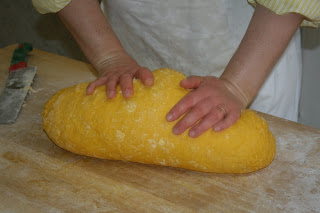
Kneading the dough
Now, knead the pasta on a floured board by pushing it away from you with the heel of your palms, folding it over, and pushing it away again, until the pasta loses its stickiness and becomes elastic. You can do all this using a food mixer. Don’t begrudge this part of the process; it produces pasta that is more easily worked and doesn’t stick. Then, wrap it in cling film and leave it to rest for an hour.

Now you roll it out. Sfogline use a matarello but you can use an ordinary pastry rolling pin. In Marcello dall’Aglio’s lab. at Borgonuovo where the take away food is made, they have an immense rolling machine which is less romantic but very fast for large quantities. Or you can use a domestic pasta machine. Don’t skimp on the number of times you feed the pasta through the machine. Three or four times at each width setting will produce smoother, silkier pasta. Once the pasta is rolled, it can be sliced to make tagliatelle (usually 6-8mm wide), or the broader pappardelle, or cut up into rectangles for lasagne or stuffed. If you are making stuffed pasta, don’t let it go dry, otherwise it will be difficult to seal the edges together.